From (Powell et al. 2024)
The extensive causal mapping literature provides many examples of its use to answer evaluation questions (see Powell, Copestake, et al., 2023, p. 110), for example:
- Getting an overview of respondents’ "causal landscape". This can be useful for orientation or for particular tasks like triaging masses of information to identify key outcomes and possible causal pathways when planning an Outcome Harvesting (Wilson-Grau & Britt 2012) or Process Tracing (Befani & Stedman-Bryce 2017) project.
- Weighing up evidence about contribution: in particular, tracing back and comparing the possibly multiple contributory causes of an important outcome or consequence (Goertz & Mahoney 2006), or examining effects of causes.
- Reporting key metrics of the causal network, for example, to reveal which factors are most central in the whole network or to identify feedback loops.
- Asking whether the empirical ToC matches the plan (Powell, Larquemin, et al., 2023, p. 7).
- Making comparisons between groups or across timepoints.
One way to simplify is to derive from the global map several smaller maps that focus on different features of the data. For example, maps may selectively forward-chain the multiple consequences of a single cause – including those activities being evaluated: effects of causes (Goertz and Mahoney, 2006) – or trace back to the multiple contributory causes of an anticipated or highly valued outcome or consequence: causes of effects. A series of simpler causal maps, each selected transparently to address a specific question, generally adds more value to an evaluation than a complicated, if comprehensive, single map that is hard to interpret. The downside of this is that selectivity in what is mapped and is not mapped from a single database opens up the possibility of deliberate bias in selection, including omitting to show negative stories.
!
Sets of individual links with the same influence and consequence factor (co-terminal links) are usually represented bundled together as a single line, often with thickness of the line indicating the number of citations, and/or with a label showing the number of links in the bundle. The map has not fundamentally changed, but the visualisation is much simpler.
Simplification - factor and link frequency
Summary
This extension is about simplifying a causal map by keeping only the most frequently mentioned:
- links (really: bundles of co-terminal links, i.e. repeated claims with the same cause and effect), and/or
- factors (the most mentioned concepts/themes).
It is best thought of as:
- a filter (a selection rule applied to derived counts), plus
- an interpretation rule (what “frequency” means and what it does not mean).
Core parameters (plain language)
Both the link-frequency and factor-frequency versions share the same conceptual parameters:
- Mode:
- Minimum: keep everything with count at least the threshold you set
- Top N: keep the N highest-count items
- Count unit:
- Citations: count coded link rows (sensitive to verbose sources)
- Sources: count distinct sources (each source contributes at most 1 to an item)
- Tie rule (important for Top N):
- selection typically respects ties at the cutoff: if the Nth and (N+1)th items have the same count, you either keep all items at that count or none (to avoid arbitrary chopping).
Link frequency (keep the most frequent relationships)
What the filter operates on
Strictly, this operates on link bundles, not raw individual coded claims.
Start from the current links table (one row per coded claim), then bundle rows that share the same cause and effect labels.
For each bundle we compute at least:
- citation_count: number of underlying link rows in the bundle
- source_count: number of distinct sources contributing at least one row to the bundle
Then the filter keeps only those bundles meeting the frequency rule (Minimum ≥ k or Top N, using Sources or Citations).
Interpretation rule (“what a link means”)
On a map, we often say “link” but we mean:
the bundle representing “many similar claims that one factor influences another”.
So “this is a frequent link” means “this cause→effect pairing is frequently claimed”, not “the effect size is large”.
Factor frequency (keep the most frequent concepts)
What the filter operates on
Factor frequency is derived from the links table by first computing a factors table (one row per factor label), with counts such as:
- citation_count: how many times the label appears as a cause or effect across coded claims
- source_count: how many distinct sources mention the label at least once
The factor-frequency rule (Minimum or Top N, using Sources or Citations) selects a set of “kept” factors.
How this simplifies the map
Once you select the “kept” factors, you simplify the map by keeping only the links whose endpoints are both in that kept set. (In network terms, you are looking at the subgraph induced by the most frequent factors.)
This usually has a nice property: it removes “long tail” concepts while preserving the main structure of the story-space.
What frequency is (and is not)
- Frequency is a measure of evidence volume / breadth:
- citations ≈ how much is said (including repeated mentions)
- sources ≈ how widely something is shared across participants/documents
- Frequency is not a measure of causal effect size, nor of truth.
- Any frequency-based simplification is therefore a pragmatic reading strategy: it prioritises what is most commonly claimed so you can interpret a complex map without being overwhelmed.
Examples (contrasts) from the app
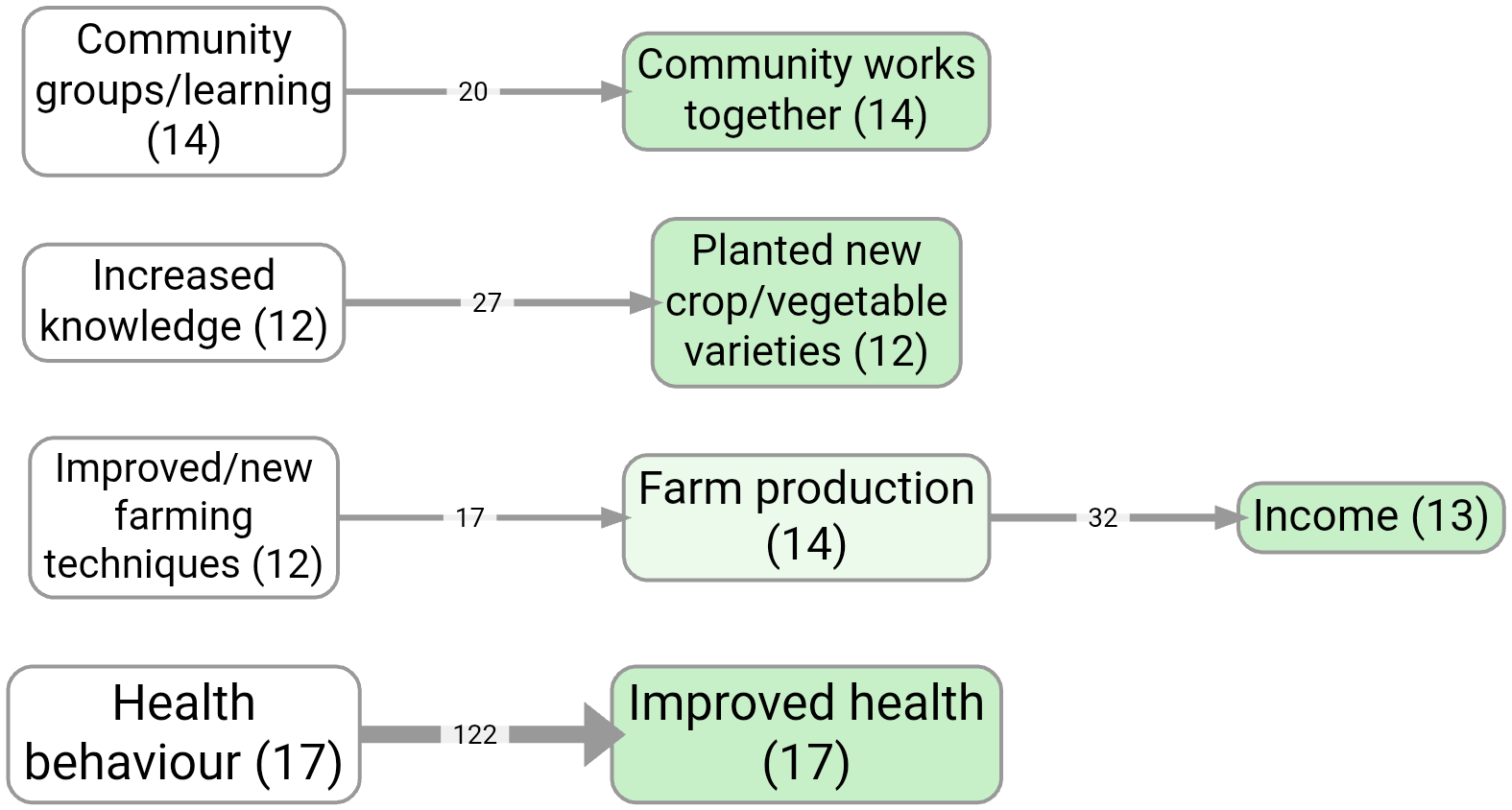
Link frequency (keep the most frequent relationships)
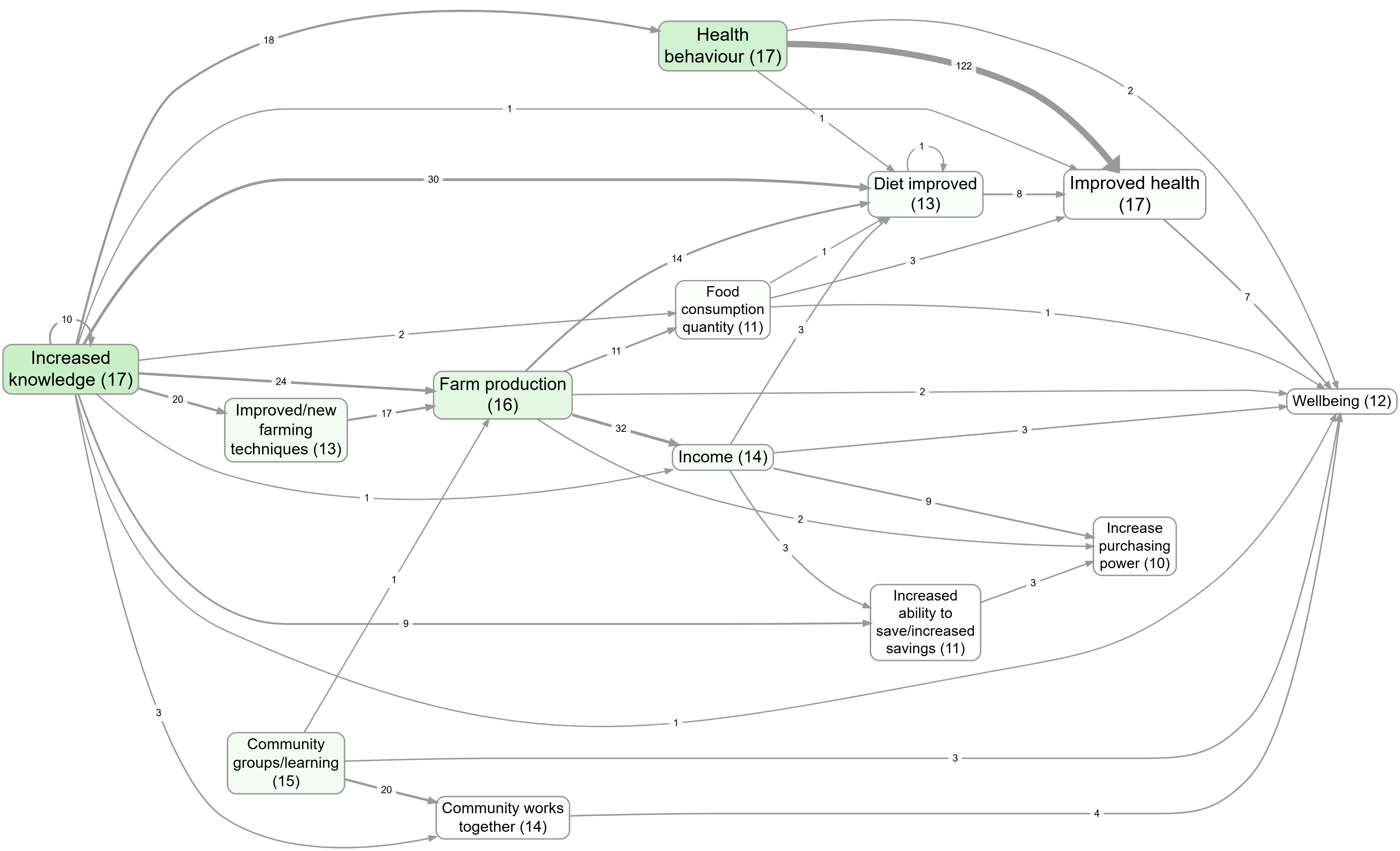
Bookmark #1124 shows a “main links” map created by keeping only the most frequent link bundles (cause→effect pairs).
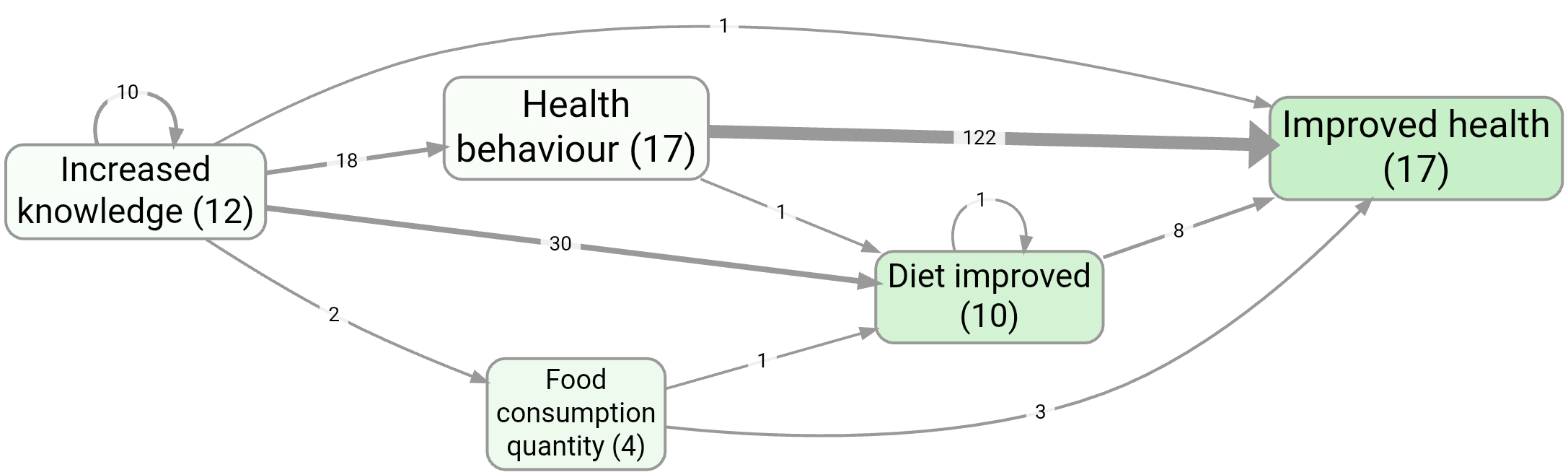
Factor frequency (keep the most frequent concepts)
Bookmark #266 shows a “main factors” map created by keeping only the most frequent factors.
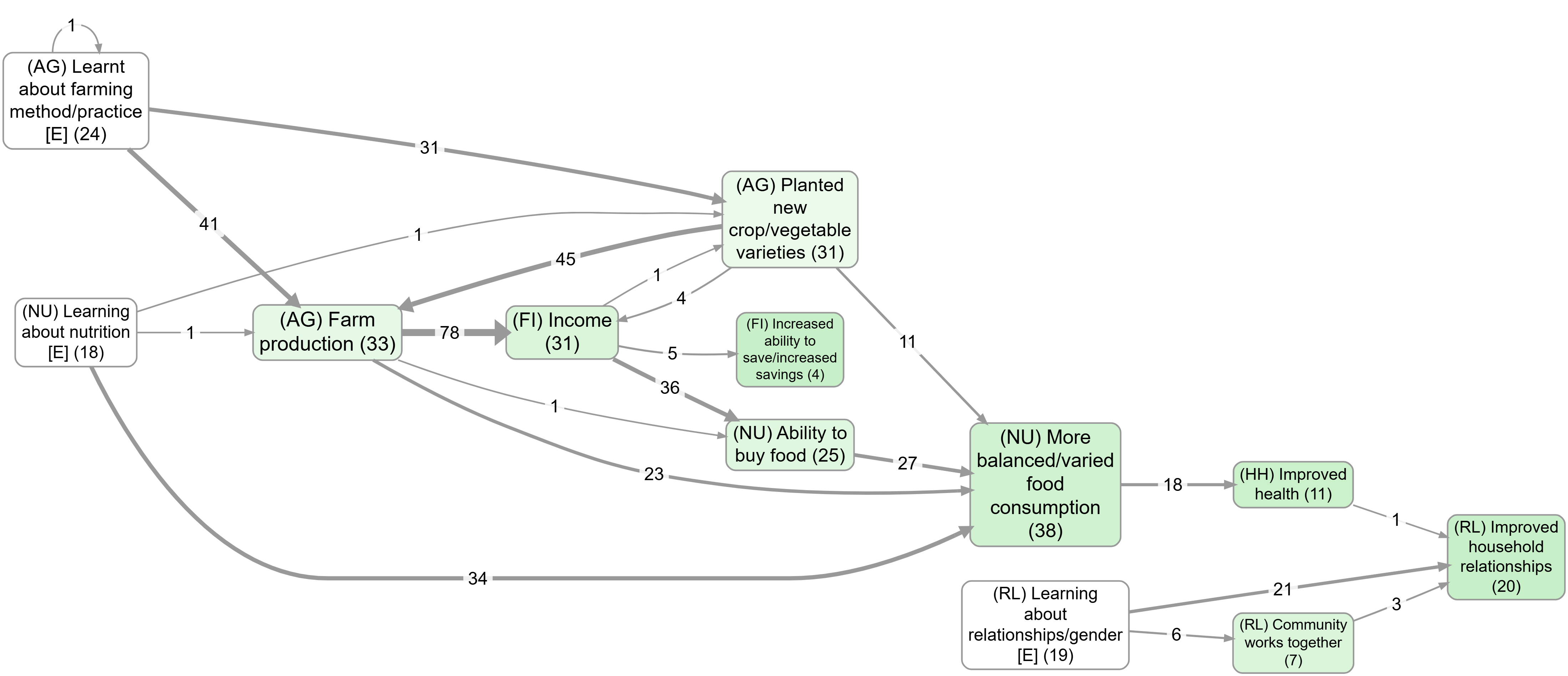
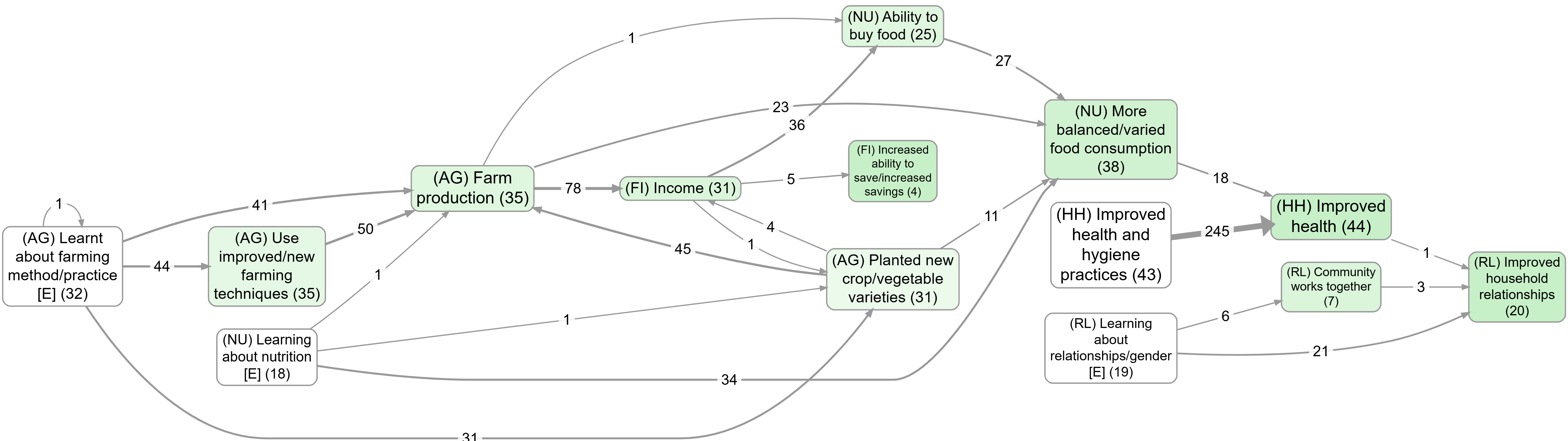
A useful contrast: top factors with vs without zoom
These two views use the same “top factors” idea but differ in granularity because zooming rewrites hierarchical labels to a higher level:
After simplification: reading “importance” (not just frequency)
Frequency tells you what is mentioned most often. A complementary reading is: which factors are influential in the network (e.g. they influence many factors which are themselves influential)?
Bookmark #1063 shows “importance” colouring after simplifying.
Formal notes (optional)
- In Top N mode, selection often respects ties at the cutoff: if the Nth and (N+1)th items have the same count, keep all items at that count (or none), rather than chopping arbitrarily.
- Link-frequency bundling can be defined formally by grouping on (cause label, effect label) and computing
source_countandcitation_countper group.
Transformation and interpretation rules
Transformation rule
- Input: a links table plus frequency settings (mode:
MinimumorTop N; count unit:CitationsorSources). - Transformation: either (a) bundle links and rank/filter bundles by frequency, or (b) derive factor frequencies and keep only links between kept factors.
- Output: a simplified links table/map with fewer displayed links and/or factors.
Interpretation rule
- Frequency means reported volume or breadth (
CitationsvsSources). - It helps simplify and orient analysis, but does not measure causal strength or truth.
See also
- Formatting your map for what you want to show for how this filter sits in a real workflow.
Another way to simplify a global causal map is to produce an overview map showing only the most frequently mentioned factors and/or links. Care should be taken if this leads to omitting potentially important but infrequently mentioned evidence about, for example, an unintended consequence of an intervention.
!
Another common way to simplify is to combine sets of very similar factors into one. For example, if hierarchical coding has been used, it is possible (with caveats) to ‘roll up’ lower-level factors (such as health behaviour; hand washing and health behaviour; boiling water) into their higher-level parents (health behaviour), rerouting links to and from the lower-level factors to the parent (Bana e Costa et al., 1999).
Large causal maps can also be analysed quantitatively, including by tabulating which factors are mentioned most often, identifying which are most centrally connected or calculating indicators of overall map density, such as the ratio of links to factors (Klintwall et al., 2023; Nadkarni and Narayanan, 2005). We are wary of the value of summarising maps in this way, not least because results are highly sensitive to the granularity of coding. For example, although a specific factor such as ‘improved health’ might have been mentioned most often, if two subsidiary factors had been used instead (such as ‘improved child health’ and ‘improved adult health’), these two separate factors would not have scored so highly.
Tasks 2 & 3 — Extensions — Introduction
References
Befani, & Stedman-Bryce (2017). Process Tracing and Bayesian Updating for Impact Evaluation. http://dx.doi.org/10.1177/1356389016654584.
Goertz, & Mahoney (2006). A Tale of Two Cultures: Qualitative and Quantitative Research in the Social Sciences. Princeton University Press. 12345.
Powell, Copestake, & Remnant (2024). Causal Mapping for Evaluators. https://doi.org/10.1177/13563890231196601.
Wilson-Grau, & Britt (2012). Outcome Harvesting.